Waterfall Hopping on Bohol: Which Falls Are Worth the Drive, and When Not to Swim
Updated September 25, 2026 · 7 min read
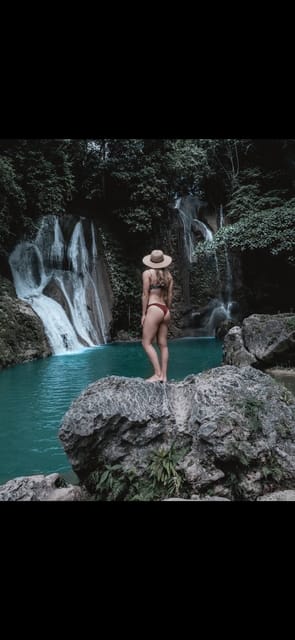
Bohol’s waterfalls are not on the coast. They are inland, scattered across half a dozen municipalities, and the road between them is the actual content of a waterfall day. Fifty offerings sit under waterfalls and caves from €18.92, and what separates a good one from a wasted day is not the falls themselves but which ones the driver picked and what the river was doing that week.
The geography nobody mentions until you are in the van
The tallest waterfall on the island is Can-umantad, in Candijay on the east coast. It drops about 60 feet in tiers – the name comes from can-uman, sixty – and it sits above the Cadapdapan rice terraces, which is why photographs of it look like two attractions at once.
It is also two to three hours from Panglao each way. That is the single most useful fact about Bohol’s waterfalls and it is missing from almost every listing. A day built around Can-umantad is a driving day with a swim in it. If that is what you want, it is genuinely beautiful and the terraces alone justify it. If you were expecting three waterfalls before lunch, you have booked the wrong thing.
The falls that fit into a normal day are closer and further west:
- Mag-aso Falls, Antequera – roughly 35 km from Panglao, about an hour to an hour and a half. Entrance is ₱20 to ₱50, plus a small parking charge. The most developed of the group, with steps down to the pool.
- Ingkumhan Falls and Pahangog Falls, both in Dimiao – around ₱20 each. Pahangog is the one usually sold as “Dimiao Twin Falls”. Ingkumhan has the rope swing and the jumping rock, which is either the reason to go or the reason not to.
None of these fees are large. All of them are cash, in pesos, in small notes, collected at a hut by someone who will not have change for a ₱1,000 bill.
The season decides which waterfall you get
This is the part that turns a good review into a bad one, and it has nothing to do with the operator.
Dry season, roughly November to May: clear water, sure footing on the approach, a calm pool you can actually swim in. The trade-off is volume. Late in the dry season some of these faces carry little more than a sheet of water, and the photograph you booked from was taken in September.
Wet season, roughly June to October: full flow, spray, the dramatic version. Also brown water, a slick and muddy approach track, and days when swimming is simply a bad idea.
Neither is the right answer. But if the waterfall is the reason you came to Bohol rather than a stop on a countryside loop, ask the operator what the flow has been doing that week. They know, and a good one will tell you it is not worth it rather than drive you three hours to a trickle.
The flash flood rule
Here is the thing that belongs in every waterfall article and is almost never in one.
These are small catchments. They react fast. Rain falling on the ridge above can lift the stream where you are standing while you are still in sunshine, and the first you know of it is the water.
Get out and get uphill if you see any of these: the water rising, the water turning brown, or leaves and twigs starting to come down. Not “wait and see”. Out.
There are no lifeguards at these sites. There is no rescue cover on the trails. Bohol’s emergency system, TaRSIER 117, is a genuinely good province-wide service – it runs from Tagbilaran, operates around the clock and has six satellite stations: Carmen, Balilihan, Loon, Jagna, Ubay and Talibon. Short-dialling 117 works from a local number; from a foreign SIM, save the mobile lines before you go (Globe 0917 510 1490, Smart 0949 795 5530). From a pool in Dimiao or Candijay, help is still an hour or more away before anyone starts moving. That is not a reason to stay home. It is a reason to take the brown-water rule seriously rather than treat it as boilerplate.
Also: the jumping rocks. Depth changes between seasons. A rock that was safe in March is not automatically safe in November, and nobody re-measures it for you.
What “secret jungle trails” actually means
The guided waterfall and jungle trail day is the most-booked version of this, at €36.90 for seven hours with hotel pickup, 4.7 stars from 239 reviews. It is a small-group trip with local guides and a flexible route, which is the honest description – the route flexes with the water.
“Secret” is marketing. These are not undiscovered places; they are places with a footpath instead of a car park. What you are actually buying is somebody who knows which approach is passable this week and which pool is deep enough today. On this particular island, in this particular terrain, that is worth more than it sounds.
Wear shoes you can walk a wet, rooty path in. Not flip-flops. The falls are ten minutes from the road, but those ten minutes are the part people fall on.
Getting there, and whether you need your own vehicle
Most waterfall days are sold with hotel pickup, and for a single day that is the easy answer. The question gets more interesting if waterfalls are a theme rather than an outing.
The sites are spread from Antequera in the west to Candijay in the east, they open early, and the good light is early. A van with a driver – the normal Bohol arrangement, and what you get on a private tour from €33.84 – covers that without you navigating anything. But if you are chasing several falls across several days and want to leave at six because the pool is empty at six, your own vehicle starts to make sense, and you can compare car hire for Bohol before you land. Read the excess and the deposit on the supplier’s own page; those terms differ between suppliers and we do not quote them here.
Inland roads are narrow, and the last stretch to several of these falls is concrete that turns to dirt. That is worth knowing before you pick the smallest cheapest car.
When to skip it
- You have one full day on Bohol. Do the countryside loop instead. The waterfalls will still be there next trip.
- You are travelling with small children. The approach paths, the slippery rock and the no-lifeguard reality make this a poor fit. Bohol with kids covers what works better.
- It has rained hard for two days. Ask, and be willing to accept the answer.
- You mainly want to be in water. The reef is the better version of that. Diving and snorkelling starts at €28.38, and the water is clear regardless of what the rivers are doing.
And if the interior is what draws you generally, the tarsier sites and the firefly kayak on the Abatan are inland too, and neither depends on the rain.