Seeing Tarsiers on Bohol: Corella, Loboc, and Why the Difference Matters
Updated September 25, 2026 · 6 min read
Almost every listing on this island promises “tarsier viewing” and stops there. It does not say where. That omission is the whole subject of this page, because there are two places on Bohol that show tarsiers to visitors and they are not the same kind of place at all.
What you are actually looking at
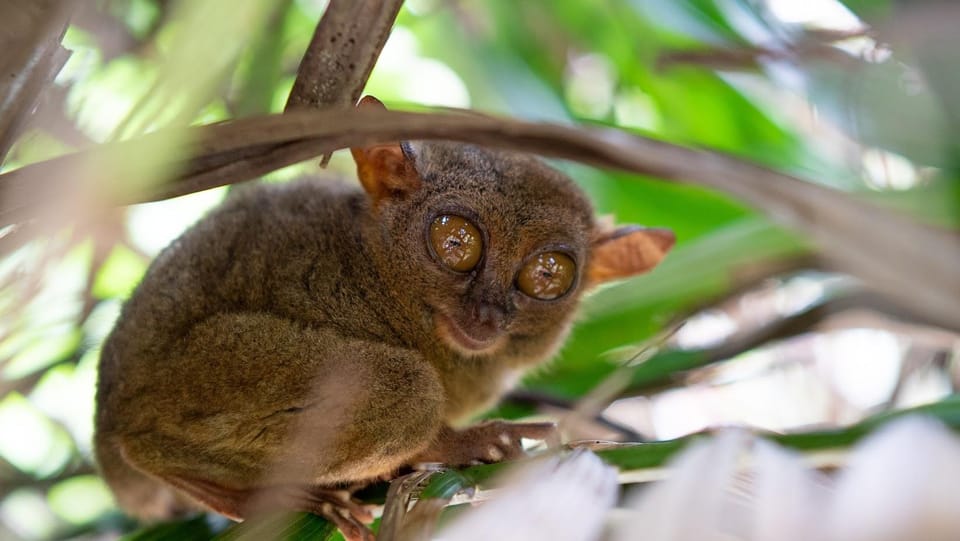
The Philippine tarsier is roughly the size of a fist, nocturnal, and eats insects. Its eyes are so large in proportion to its skull that they cannot move in their sockets – which is why it swivels its head instead, almost all the way round. It is not a monkey, despite what half the signage on the island says, and it is protected under Philippine law.
The part that matters for a visit: it is awake at night and asleep during the day, when you will be there. Everything you see is an animal being looked at while it sleeps. That is tolerable when it is done quietly and at a distance. It is not tolerable when a coachload of people is clapping at it.
Corella: a fenced piece of forest
The sanctuary at Corella, about twenty minutes inland from Tagbilaran, is run by the Philippine Tarsier Foundation with backing from the environment and tourism departments. The animals live in 167 hectares of protected timberland. They are not placed anywhere. Staff go out each morning and find where they have settled, and guides then walk small groups along a short trail to those spots.
The rules follow from the biology and are enforced by the guides:
- No flash. A tarsier’s eyes are built for near-darkness; a flash at close range is exactly the wrong thing.
- No touching, and no handling for photographs.
- Keep your voice down – whispering, not talking.
- A few minutes per animal, then move on.
Entry is around ₱150 per person, with a reduced rate for students, seniors and PWD, and the site opens in the morning and closes at 4pm, with last entry about half an hour before that. Go early. Both for the light and because the tour buses arrive later.
Loboc: a viewing path with a shop at the end
The conservation area at Loboc works differently. A 2018 SunStar editorial comparing the two described its tarsiers as “moved from their natural habitat and positioned along strategic niches” accessible to visitors on a walking tour, with the educational briefing “discontinued” and the route ending in a souvenir shop. Its description of what happens next is the reason this article exists: visitors disregard the posted requests for silence and make noises to “awaken the tarsiers so the visitors can take better selfies.”
Conservation groups also report that the Loboc animals are caged at night. A tarsier that is stressed in captivity is known to injure itself, and the species does not breed well under those conditions.
We are not going to pretend this is a close call. If your tour stops at Loboc and you would rather it did not, say so when you book, not in the car park.
How to find out which one your tour visits
This is the practical problem, and it has a practical answer.
Most of the 70 listings under tarsiers and dolphins and the 65 under Chocolate Hills and countryside name no site at all. A few do. The ones that say Corella or Philippine Tarsier Sanctuary in the listing text are telling you something; the ones that say Tarsier Sanctuary without a place name are not.
What works:
- Read the itinerary, not the title. The stop list on the booking page sometimes names the municipality even when the headline does not.
- Ask before you pay, in writing. Operators answer messages on the booking platform, and an answer in writing is worth more than one shouted over a minibus engine.
- Look at the running order. A tour that goes Loboc river lunch → tarsiers → Chocolate Hills in that sequence is probably using the Loboc site, because it is a five-minute detour from the river landing. Corella sits off the direct road and costs the driver time.
Point three is an inference, not a guarantee. Treat it as a reason to ask, not as an answer.
If you would rather go on your own
Corella is easy to reach independently and usually a half-day. From Panglao or Tagbilaran it is a short drive; a tricycle or a hired motorbike does it, and a van with a driver does it more comfortably for a family. Get there at opening time and you may well walk the trail with two other people instead of twenty.
Most visitors to Bohol never drive themselves – a van with a driver or a scooter is the normal arrangement here, and the roads inland are narrow. But if you are combining Corella with the east coast or with waterfalls and caves over several days, your own vehicle starts to make sense, and you can compare car hire for Bohol before you land. Read the excess and the deposit on the supplier’s own page; those terms vary and we do not quote them.
What a good tarsier stop looks like
Thirty to forty-five minutes, two or three animals, a guide who points them out and explains what you are seeing, and nobody raising their voice. If the guide reaches into the foliage to turn an animal towards a camera, that is the moment to stop taking photographs – it is the clearest signal available about the operator you have booked.
The guided countryside loop is where most people meet a tarsier for the first time. It is worth knowing, before that day, which of the two sites you are being driven to.