Whale Shark Snorkelling from Bohol: It Is Not on Bohol, and That Changes the Question
Updated September 25, 2026 · 8 min read
Search for whale sharks on Bohol and you will find trips sold under a Bohol heading, with Bohol hotel pickup, at Bohol prices. None of them swim with whale sharks on Bohol.
They cross to Oslob, on the south-east coast of Cebu. That is a different island, a different province, and a boat ride each way. It is also the single most controversial wildlife attraction in the Philippines, and the reason for that controversy is not a matter of opinion – it is what makes the sightings reliable in the first place.
This article exists because the listing will not tell you either of those things.
The day, in hours
The whale shark snorkelling trip sold from Bohol runs about seven hours and costs €115.11. It holds 3.9 stars from 83 reviews – no other listing in our inventory with more than eighty reviews sits lower. That is worth pausing on, because it is not a badly run tour. It is a long day with a short payoff.
The crossing from Panglao to Oslob takes roughly an hour and a half to two hours each way, depending on the boat and the sea. Longer versions of this day, with Tumalog Falls or a Cebu stop added, run to ten hours or more.
Your time in the water with the animals is thirty minutes. That is not the operator being mean; it is the rule at Tan-awan, where the interaction happens, and it is enforced by slot.
So: three to four hours of travelling, a queue, a briefing, and half an hour in the water. If that maths works for you, fine. If it does not, you find that out on a morning when the boat has already left and the day cannot be undone.
Why the sharks are there
This is the part that matters.
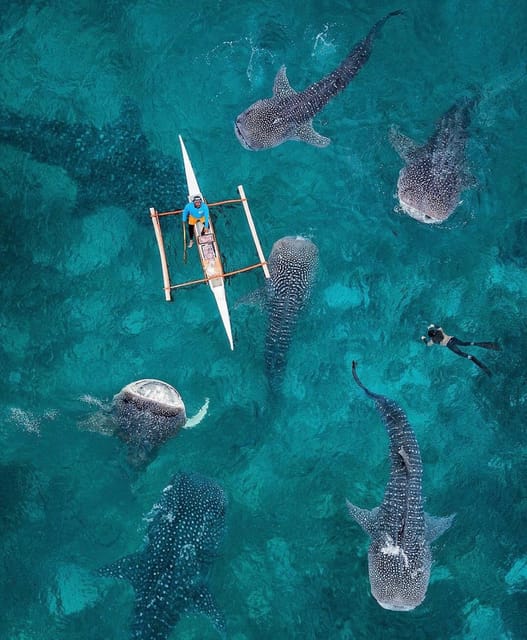
Whale sharks do not naturally congregate at Tan-awan. Since the operation began in 2011, local boatmen have hand-fed them – small shrimp, from outriggers, every morning – and that is why the animals are there when your boat arrives in the morning. The interaction window at Tan-awan is a morning one and closes around midday. Oslob has grown into the largest whale shark tourism operation in the world on exactly this basis.
The feeding is the product. Without it there is no guarantee, and the entire business is built on the guarantee.
What the research found, not what the internet says
You can find people shouting in both directions about Oslob. The peer-reviewed work is more specific and more useful:
- Sharks newly identified at the site learn to arrive earlier over time, which is the signature of animals associating a place with a food reward rather than following their own movements.
- Animals with a longer history at the site are less likely to avoid being touched or bumped by boats. Habituation is measurable.
- Whale sharks at Oslob carry significantly more injuries than populations studied at non-provisioning sites in Australia, Mozambique and the Seychelles.
The last point is the one conservation biologists keep returning to, and the concern extends past Oslob itself: an endangered animal that has learned boats mean food is an easier animal to find, and whale sharks are hunted elsewhere in the region.
In late May 2026 the sharks simply did not turn up for four days and guests waited out the slots for nothing. The town said the animals had followed plankton to a neighbouring barangay and that nothing had been closed. That is not proof of anything on its own. It is a reminder that “guaranteed” was always a business promise rather than a biological one.
The rules, and whether they are kept
There is a code of conduct at Tan-awan: stay four metres away, do not touch, no flash photography, and no sunscreen at all. If you have any on you are asked to rinse it off before boarding; the chemicals damage the animals’ skin. The watching fee at Tan-awan is reported at around ₱1,000 per person for foreign visitors and about half that for Filipinos; whether it is included in what you paid depends on your operator, so ask rather than assume, and bring pesos.
Compliance is the weak point, and it is mostly not the guides. Thirty minutes, a lot of people, a shark the size of a bus and a phone in a waterproof case is a combination that produces exactly the behaviour the rules exist to prevent. If you go, you can at least be the person who keeps the four metres.
The alternative, and why it is not a day trip
The honest comparison is Donsol, in Sorsogon. No feeding, no baiting, no chumming – former fishermen retrained as spotters, wild animals passing through on their own business, and international recognition for getting it right. The season runs from about mid-November to mid-May, with the best sightings February to April, and there is no guarantee at all, which is rather the point.
Donsol is on Luzon. It is not reachable from Bohol as a day trip, or as a weekend, realistically. So the choice this page can actually offer you is not “Oslob or Donsol” – it is Oslob, or not this trip.
There is no non-provisioned whale shark encounter within reach of a Bohol holiday. Anyone who tells you otherwise is selling you Oslob with better wording.
What we would do with the day instead
Not a moral instruction – a practical one. If the reason you want whale sharks is “large wild animals in clear water”, Bohol has versions of that which do not depend on feeding:
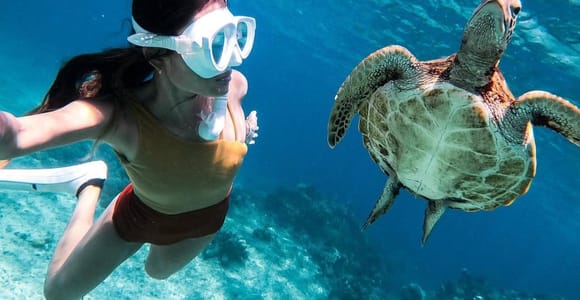
- Dolphins and turtles from Panglao – wild spinner dolphins, green turtles on the seagrass at Balicasag, no provisioning anywhere in it. Under tarsier and dolphin tours from €16.74.
- The reef itself. Diving and snorkelling from €28.38. Balicasag’s wall is the reason divers come to this island, and the daily cap on divers there exists precisely because somebody did the arithmetic that Oslob did not.
- Island hopping from €17.67, if the boat day rather than the animal is what you are after.
And if you do go to Oslob, go with your eyes open rather than being surprised by the outriggers in the photograph. It is a real encounter with a real animal. It is also a feeding station, and the reason it works is the reason it is argued about.
If you are travelling with children
The thirty-minute slot is in open water with a lot of boats and a lot of people, after a crossing of an hour and a half to two hours that starts before dawn. Operators set their own age limits and we are not going to print one that might be wrong at the counter – ask on the booking page. For what actually suits a family week here, Bohol with kids is the more useful page, and the countryside loop is the day most families end up glad they booked.